
- Key Takeaways
- What Drives CNC Machining Cost?
- How Does Order Quantity Change the Price per Part?
- Is Aluminum Cheaper to Machine Than Stainless Steel?
- How Much Do Tighter Tolerances Add to the Cost?
- What Does Surface Roughness Cost?
- How Much Do Surface Finishes Add to the Price?
- What Is the Hourly Rate for CNC Machining?
- How to Reduce CNC Turning Costs
- FAQ
The cost of CNC machining depends on the size and complexity of the part, the material used, and how many units are ordered.
Using instant quotes from Boda's China facility, we priced twoCNC turned partsin aluminum (6061), stainless steel (304), and carbon steel (Q235). In each case, we set ISO 2768-m tolerances and a standard Ra 3.2 µm finish. For single pieces, prices ranged from $29.50 to $42.93, depending on the part and material. But for orders of 1,000 units, the range dropped to $2.77 to $12.56 per unit.
This shows that order quantity is the main driver of CNC machining cost. The type of material has the second highest impact on the price, and it makes a bigger difference at higher volumes.
KEY TAKEAWAYS: KMC GREEN CHECKLIST CARDKey Takeaways
The cost of CNC machining mainly depends on order quantity, due to the one-time setup expenses that come with every production run.
Stainless steel is more expensive than aluminum, in part because it work-hardens quickly and is more difficult to machine.
Complex designs with multiple features are more expensive due to the added machine time.
Powder coating and other surface finishes can also add to the cost of each unit.
Table of Contents
- Key Takeaways
- What Drives CNC Machining Cost?
- How Does Order Quantity Change the Price per Part?
- Is Aluminum Cheaper to Machine Than Stainless Steel?
- How Much Do Tighter Tolerances Add to the Cost?
- What Does Surface Roughness Cost?
- How Much Do Surface Finishes Add to the Price?
- What Is the Hourly Rate for CNC Machining?
- How to Reduce CNC Turning Costs
- Frequently Asked Questions
What Drives CNC Machining Cost?
Based on our quotes, these six factors had the greatest influence on price (listed in order, from biggest to smallest impact):
- Order quantity: the per-part price dropped by 71 to 91% when increasing the order from one piece to 1,000 pieces.
- Size and features: running a larger, more complex part through our platform gave us a quote about 3x higher than a simple part for a 1,000 piece order (but only 19 to 35% higher for a single piece).
- Material: SS304 costs 42 to 53% more than 6061 aluminum at 1,000 pcs.
- Surface finish: ranges from 1 to 22% higher at 1,000 pcs.
- Surface roughness: high grade (Ra 0.8) costs about 8 to 10% more compared to standard (Ra 3.2) for single-piece orders.
- General tolerance class: moving from ISO 2768-c to 2768-f increases the cost by 4 to 5% for single-piece orders.
Unless stated otherwise, all parts in this article are quoted in USD per unit at ISO 2768-m, standard roughness (≤3.2 µm Ra), with no finish on aluminum and stainless, and antirust oiling on carbon steel.
| Part | Outer diameter | Features (as detected by the platform) |
|---|---|---|
| A: Simple | 25 mm | 1 hole, 2 fillets |
| B: Complex | 55 mm | 3 holes, 2 chamfers, 1 counterbore, 7 countersinks |
How Does Order Quantity Change the Price per Part?
Any CNC machining order will have one-time setup costs, including tool setting, programming, and the first part inspection. Those costs are amortized across the entire order. So when you order a single unit, that piece carries these entire costs. But on orders of 1,000 units, these costs are split across each piece.
| Part | Material | 1 pc | 10 pcs | 100 pcs | 1,000 pcs | Saving, 1 → 1,000 |
|---|---|---|---|---|---|---|
| A: Simple | Aluminum 6061 | $29.50 | $5.99 | $3.25 | $2.77 | −91% |
| A: Simple | Stainless SS304 | $31.77 | $7.54 | $4.53 | $3.93 | −88% |
| A: Simple | Carbon steel Q235 | $33.57 | $6.53 | $3.44 | $2.91 | −91% |
| B: Complex | Aluminum 6061 | $35.97 | $12.86 | $9.23 | $8.21 | −77% |
| B: Complex | Stainless SS304 | $42.93 | $18.52 | $14.02 | $12.56 | −71% |
| B: Complex | Carbon steel Q235 | $39.95 | $13.39 | $9.41 | $8.35 | −79% |
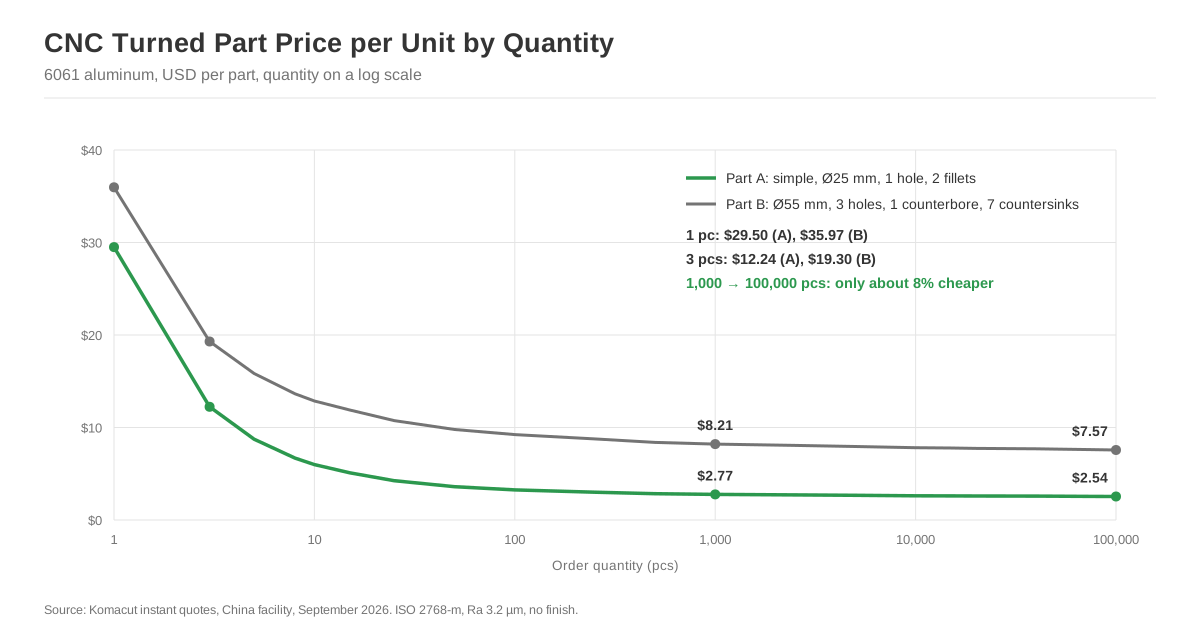
The more complex Part B sees lower savings at volume, compared to the simpler Part A. That's because its features (counterbore, countersinks, chamfers) require additional machine time, and this added cost doesn't spread across the batch but scales with every piece added to the order.
As the curve above shows, the setup cost is the bulk of the unit price at small quantities. But on an order of 100,000 pieces, the price of each part is almost entirely made up of the run cost. So if you subtract the per-part price at 100,000 pieces from the per-part price for a single piece, the remainder is roughly the fixed cost of the order. In the quotes we pulled, it amounted to $27 to $32.
This is why other considerations, like design complexity, become a bigger factor at larger quantities. At 100,000 pieces, our simple Part A runs at $2.54 per piece, while our more complex Part B comes up to $7.57 due to its added features and larger diameter.
Ordering Multiple Prototypes Is More Cost-Effective Than Ordering One
IMAGE ROW: IMAGE LEFT / TEXT RIGHT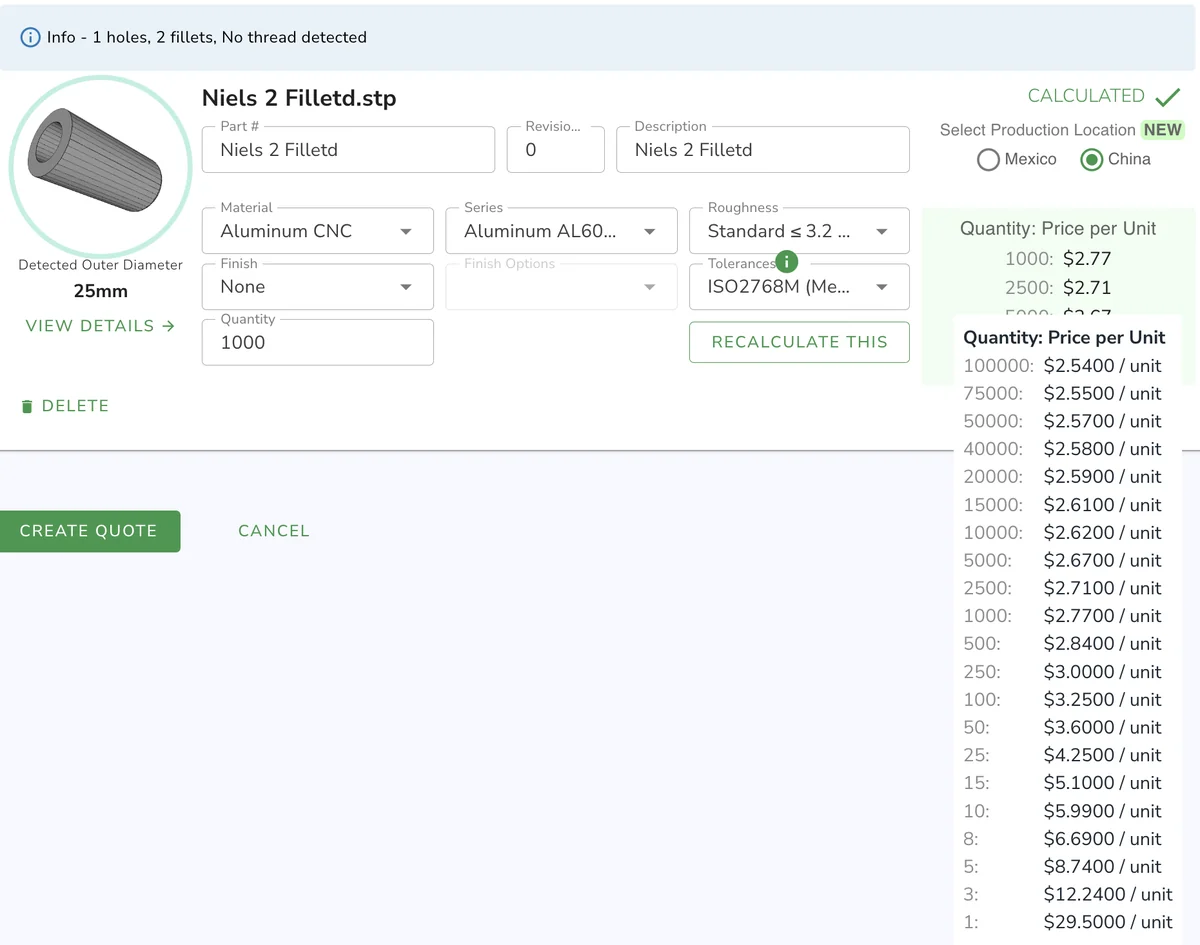
The steepest price drop happens when you move from one piece to multiple pieces.
For our Part A (in aluminum), one piece will cost you $29.50, three will cost $12.24 each, and five will run you only $8.74 per unit. In other words, ordering three pieces will cost you $36.72, which is only $7.22 more than ordering a single piece. So if you'll need a spare, a test sample, or a second piece for a fit check, order them as part of your first batch to get a much lower price per piece.
Savings Flatten After 1,000 Pieces
Across every part we tested, changing the order quantity from 1,000 to 100,000 shaved down the unit price by only 7.6 to 8.3% (for Part A in aluminum, that meant a drop from $2.77 to $2.54).
So above 1,000 units, adding to the order quantity has minimal impact on cost. At that point, the only real way to save further is to change the design so it has fewer features, uses a cheaper alloy, or uses less material.
Is Aluminum Cheaper to Machine Than Stainless Steel?
Yes, and the difference is even more prominent at higher volumes.
A single piece made of 304 stainless steel will cost you about 8 to 19% more than the same piece in 6061 aluminum. But for 1,000 pieces, opting for stainless steel will cost you 42 to 53% more. That's because setup cost makes up the bulk of the price when ordering a single piece, while the choice of material has a bigger impact at volume.
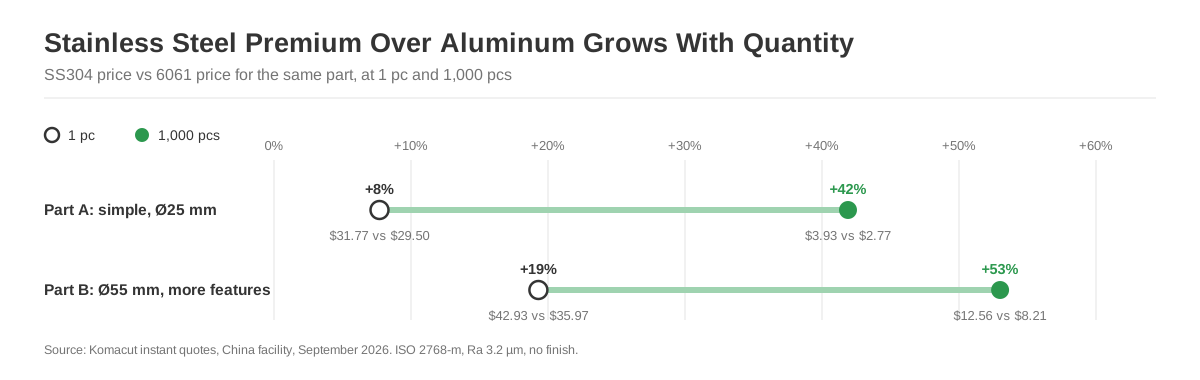
The stainless steel premium is even higher on Part B because it has more features to cut and stainless steel is difficult to machine. According to a 2026 study inMachines, this is due to the material'slow thermal conductivity (about 16 W/m·K), high tendency to work-harden, and strong adhesion to cutting tools.
When ordering a prototype, the price difference for materials will be small, so select the material your part needs. But when you're ordering at production volumes, evaluate every stainless steel part or component to make sure it is necessary and worth the added cost. If it's only specified because the part needs corrosion protection, you can get that protection at a lower price with anodized 6061 or e-coated Q235 carbon steel (see the finish costs below).
For guidance on swapping materials, consult ourmetal selection guide for CNC machining.
How Much Do Tighter Tolerances Add to the Cost?
Very little if you're staying in the general tolerance classes.
ISO 2768-1sets general tolerances for any dimensions that are not given an individual tolerance on the drawing. For dimensions between 6 and 30 mm, that tolerance will be ±0.1 mm (fine class), ±0.2 mm (medium), and ±0.5 mm (coarse).
Here's how changing the tolerance affects the single-piece price for our more complex Part B design:
| Material | Coarse (2768-c) | Medium (2768-m) | Fine (2768-f) | Fine vs coarse |
|---|---|---|---|---|
| Aluminum 6061 | $34.69 | $35.97 | $36.34 | +4.8% |
| Carbon steel Q235 | $38.71 | $39.95 | $40.48 | +4.6% |
| Stainless SS304 | $41.61 | $42.93 | $43.59 | +4.8% |
We saw the same pattern when running Part A, with an increase of 3.9 to 4.3% when moving from coarse tolerance to fine.
So the takeaway here is that looser tolerance classes won't result in any big savings. Choose your tolerance class based on function, not price.
Consult ourprocess tolerances pagefor the full ISO 2768 tables for CNC turning.
What Does Surface Roughness Cost?
Boda uses four roughness grades for CNC turning, ranging from as-milled (≤6.0 µm Ra) to high grade (≤0.8 µm Ra).
Here's how it affects the price for a single piece:
| Part | Material | As milled ≤6.0 Ra | Standard ≤3.2 Ra | Fine ≤1.6 Ra | High grade ≤0.8 Ra |
|---|---|---|---|---|---|
| A: Simple | Aluminum 6061 | $28.65 | $29.50 | $30.36 | $31.95 |
| A: Simple | Stainless SS304 | $30.85 | $31.77 | $32.69 | $34.41 |
| B: Complex | Aluminum 6061 | $34.69 | $35.97 | $37.07 | $39.27 |
| B: Complex | Stainless SS304 | $41.61 | $42.93 | $44.47 | $47.33 |
| B: Complex | Carbon steel Q235 | $38.71 | $39.95 | $41.36 | $44.02 |
Changing the roughness from standard to high grade increases the price by 8 to 10%, which is about double the increase you get when moving from coarse to fine tolerance. Avoid this premium by specifying fine or high-grade roughness only on the surfaces that genuinely need it.
For a better idea of which Ra is suitable for which function, check out ourguide to CNC machining surface roughness.
How Much Do Surface Finishes Add to the Price?
When running the numbers for a single piece, every surface finish had a negligible (under 5%) impact on the price.
But for orders of 1,000 pieces, adding a surface finish increased the cost by up to 22%. That's because the finish isn't a one-time fixed expense, but a cost that gets added on to every single piece in the batch.
Here's a table showing how the choice of surface finish moves the price on an order of 1,000 pieces (compared to leaving the part unfinished, or with just antirust oiling on carbon steel):
| Material | Finish | A: Simple (Ø25 mm) | B: Complex (Ø55 mm) |
|---|---|---|---|
| Aluminum 6061 | Anodize, black | +$0.38 (+13.7%) | +$0.61 (+7.4%) |
| Aluminum 6061 | Powder coat, Black Sandtex | +$0.50 (+18.1%) | +$0.77 (+9.4%) |
| Stainless SS304 | Passivation | +$0.42 (+10.7%) | +$0.89 (+7.1%) |
| Stainless SS304 | Powder coat, Black Sandtex | +$0.53 (+13.5%) | +$1.04 (+8.3%) |
| Carbon steel Q235 | E-coating | +$0.06 (+2.1%) | +$0.11 (+1.3%) |
| Carbon steel Q235 | Zinc plating, trivalent | +$0.25 (+8.6%) | +$1.08 (+12.9%) |
| Carbon steel Q235 | Powder coat, Black Sandtex | +$0.65 (+22.3%) | +$1.04 (+12.5%) |
For the larger Part B design, the surface finishes come at a higher price but make up a smaller percentage of the part price. That's because its base price is about 3x higher compared to the smaller Part A. So be sure to budget finishes in dollars per part.
Powder coating was the most expensive finish in every case except Part B in carbon steel, where zinc plating cost 4 cents more. The cheapest was e-coating on carbon steel, which only added 6 to 11 cents per part.
For a rundown on how each type of finish performs in service, see our article onCNC machined parts surface finishing.
What Is the Hourly Rate for CNC Machining?
A shop's hourly rate combines the cost of the machine, tooling, overhead, margin, and labor. The operator's wages are the only item on that list that has a public benchmark to use for comparison. According to theU.S. Bureau of Labor Statistics, the median pay for machinists and tool and die makers in 2025 was $28.66 an hour.
But the facility's hourly rate doesn't tell you the price for your part. You also need to factor in the cycle time, setup hours, and batch size. A per-part quote based on your CAD file will already include all three, split by quantity.
How to Reduce CNC Turning Costs
IMAGE ROW: IMAGE LEFT / TEXT RIGHT
Order multiple pieces at a time.Ordering five prototypes instead of just one will significantly lower the per-unit price. Combine repeat, small-volume orders into batches: 100 pieces of our Part A design in aluminum would cost you $599 if you order them in ten separate batches, but only $325 if you order them all at once.
Remove any feature that doesn't have functional value.Every countersink, cross-hole, or chamfer on your design means extra cycle time. Eliminating some of them can net you real savings, especially for stainless steel parts.
Keep your design within general process limits.Boda uses the following DFM rules for CNC turning:
- Part diameter between 7 and 295 mm, with length between 10 and 565 mm.
- Minimum wall thickness of 2 mm.
- Minimum hole diameter and thread size of 3 mm.
- Maximum hole depth of 80 mm (or a through-hole).
- Spacing between holes (or between holes and edges) at a minimum of 2 mm.
- Milled features that are no larger than 50% of the raw stock.
- Countersinks at 30°, 45°, or 60°.
Use standard roughness instead of specifying a finer surface.That means Ra 3.2 for the entire part, with finer grades specified only where the drawing actually needs them.
At volume, only use stainless steel where necessary.At high order quantities, stainless steel carries a 42 to 53% premium, which adds up to a significant amount at 1,000 parts or more.
Choose your surface finish based on the dollar amount.On a part like our Part A in carbon steel, powder coating will cost more than fifty cents per unit, while e-coating will only be pennies.
OurCNC machining drawing guidelinescover how to call out tolerances and finishes for a more accurate quote.
Boda CTA: SOFT-WASH FULL FRAME (BEFORE FAQ)Instant Pricing
Get a price for your own part
Upload a STEP file and compare 6061, SS304 and Q235 at every quantity break in about 30 seconds, with DFM feedback on the same screen.
Frequently Asked Questions
How do I estimate CNC machining cost?
The easiest way is to let an instant quoting platform do the estimate for you. Just upload your CAD file to get a price per part at each quantity break. To calculate it manually, multiply the order quantity by the run cost, then add the fixed setup cost per order (in our tests, this was between $27 and $32, depending on the design). The run cost varies based on the size of the part, the number of features, the material specified, as well as the surface finish and roughness.
Why is CNC machining so expensive for one part?
Every CNC machining order will have one-time setup costs for fixtures, programming, and first-part inspection. When ordering a single unit, that part carries the entire setup cost (which was as high as $32 in quotes we ran on the Boda platform). Bumping the order quantity up to three pieces reduced the per-unit price by 40 to 59%, because those one-time costs were now spread across three separate parts instead of having it all land on a single unit.
How much does CNC machining cost per hour?
It depends on various factors, like where the facility is located, the machine used, and the shop's overhead. Labor cost is only one part of it (according to the BLS, the median wage for machinists and tool and die makers was $28.66 per hour in 2025). Going with a per-part quote based on your CAD file is better for budgeting than going by a shop's hourly rate.
Is it cheaper to machine aluminum or stainless steel?
Aluminum is cheaper, especially at higher volumes. Based on quotes run on the Boda platform, one piece in 304 stainless steel costs about 8 to 19% more than the same piece in 6061 aluminum, but 42 to 53% more on orders of 1,000 pieces. The premium is partly due to stainless steel being harder to machine because it has low thermal conductivity and work-hardens as it's cut.
What quantity gives the best price per part?
You get most of the volume savings by the time your order hits 100 units, and almost all of it by 1,000. In quotes we ran, moving from 1,000 to 100,000 pieces only drops the per-unit price by another 7.6 to 8.3%. For prototype runs, ordering 3 to 5 pieces gets you the best value, with three simple aluminum parts costing only a total of $7.22 more than ordering a single unit.